 Seller OS
Fiverr data entry SEO: how specialists get found
Data entry has one of the lowest barriers to entry on Fiverr and the largest pile of lookalike gigs. Buyers scanning results are not comparing skill; they are comparing fit. Can this person handle my CRM export, my product catalog, my stack of PDFs, my research list. The data type decides who gets the order.
This guide shows how to pick a single data type, phrase it the way buyers phrase it, prove accuracy without exposing client records, and price by record instead of racing to the floor. The keyword table holds examples to validate locally, not platform data.
Free plan available. Local-first data. Human review on every change.
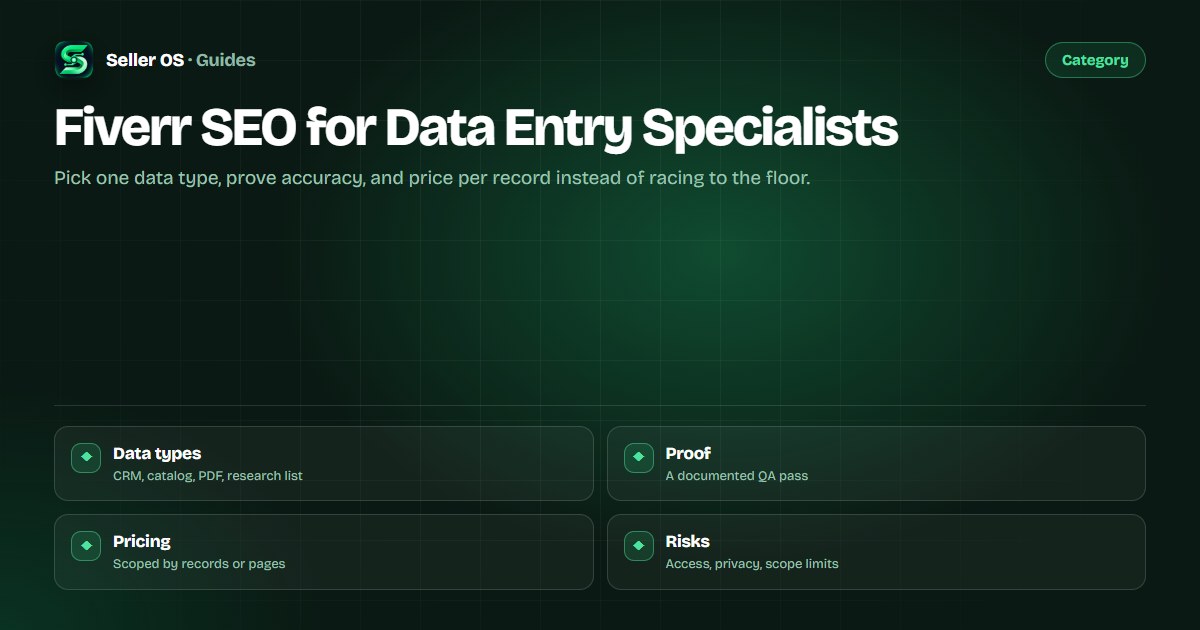
Where the data entry supply actually sits
Fiverr's public Data Entry category page, checked October 1, 2026, shows three service labels: Data Typing, Copy Paste, and Web Research. The seller titles on that page lean on formats and destinations: PDF to Excel, product listing, email leads, map scraping, PDF to Word. Buyers shop by the artifact already sitting in their hands.
That is why a listing promising generic data entry competes with rows of identical promises. The phrase worth owning names the input and the output together, because that pair is the whole search. For Fiverr data entry buyers, specificity is the only filter they have when forty gigs look the same.
- CRM cleanup — a messy export turned into consistent, deduplicated records
- E-commerce catalog — product rows built to a marketplace template
- PDF to sheet — scanned or exported documents rebuilt as a structured table
- Research list — named fields collected to a written specification
Keyword examples to validate locally
Collect phrases from the work you can actually deliver, then test each one on Fiverr: type it, read autocomplete, open the gigs ranking for it, and note what they promise and at what volume. Candidate phrases should describe a real deliverable you have completed at least once, otherwise the click leads to a conversation you cannot win.
The set below fits one seller who works in spreadsheets and contact data. Test your own candidates beside it, such as excel data entry gig or data entry jobs fiverr, and read every row as a hypothesis, since none of this is platform data and buyers may describe the same job in other words.
| Slot | Example phrase | Why a buyer types it |
|---|---|---|
| Primary | excel data entry | Format named exactly the way buyers name it |
| Secondary | pdf to excel data entry | Input plus output inside one phrase |
| Secondary | data entry virtual assistant | Shoppers looking for recurring help |
| Long-tail | product listing data entry | Catalog work with a fixed template |
| Long-tail | crm data cleanup | Higher-skill cleanup with a better rate |
Choose one data type to own first
Each data type attracts a different first question, and the answer belongs in your description before the buyer has to ask it. A cleanup buyer worries about duplicates; a catalog buyer worries about template matching; a conversion buyer worries about columns landing in the wrong place. One gig should answer one of those questions well.
The comparison below shows how the same skill reads differently across four offers. Pick the row where you already have a sample, build that gig completely, and only then consider a second listing for a different data type.
| Data type | What arrives | Buyer's first question | Proof that answers it |
|---|---|---|---|
| CRM cleanup | Deduplicated contact records | How do you treat duplicates? | A sample table with your merge rules |
| E-commerce catalog | Product rows in your template | Can you match my fields? | A test batch of ten products |
| PDF to sheet | A structured, aligned table | Will my columns line up? | A before-and-after excerpt |
| Research list | Named fields per row | Where does the data come from? | Your written spec plus sample rows |
Accuracy proof a buyer can check
You cannot show client records, so the proof becomes your checking process. Describe the pass you run on every delivery: a duplicate scan, a field-completeness count, a spot check against the source, and a short summary of what you corrected. Buyers hiring for repetitive work are buying the absence of errors, and a named process sells that better than an adjective.
Numbers make the process credible when they describe your method rather than your results. As an illustrative example only: a 1,000-row delivery with a 100-row spot check, an automated duplicate scan, and a delivery note listing three issues you found and fixed. Your own counts will differ, and they should come from work you actually ran.
Check against source
compare a sample of rows to the original file or page
Scan for duplicates
run a de-duplication pass on the key field
Count completeness
report fields left blank and why they were left
Summarize in delivery
list what you corrected before the buyer opens the file
Price per record, not per hour
Data entry buyers think in volumes: rows, pages, products, listings. Price in the same unit so a quote takes thirty seconds instead of three messages. Fiverr's gig creation article states that you can offer three packages with their own delivery times, revisions, and prices, and that the minimum starting price is $5 with higher minimums in some categories.
The ladder below is illustrative only: volumes and windows are examples to adapt, not rates observed on the platform. Set the bands from your own throughput, state the fields per record and the number of source files, and bill work above the top band as an add-on instead of absorbing it.
| Tier | Volume example | Delivery example |
|---|---|---|
| Basic | Up to 200 records from one source file | 2 days |
| Standard | Up to 750 records or two source files | 4 days |
| Premium | Up to 2,000 records plus a QA summary | 6 days |
| Add-on | Batches above the tier, priced per batch | Plus 1 day |
Data entry mistakes that end orders early
The first mistake is racing to the floor price. Opening at the minimum signals volume work, attracts buyers with the least defined scopes, and leaves no room for the checking pass that earns repeat orders. The second is writing no scope limits at all: without a stated record count, field list, and number of source files, every order drifts past its delivery window.
The third is careless handling of client data. Files stay on your machine, are never reused as samples, and are deleted after the order closes; screenshots need the same treatment. Treat privacy as part of the service, then read the virtual assistants guide for the admin work that surrounds this category and the first order guide for landing the initial buyer.
Where Seller OS helps
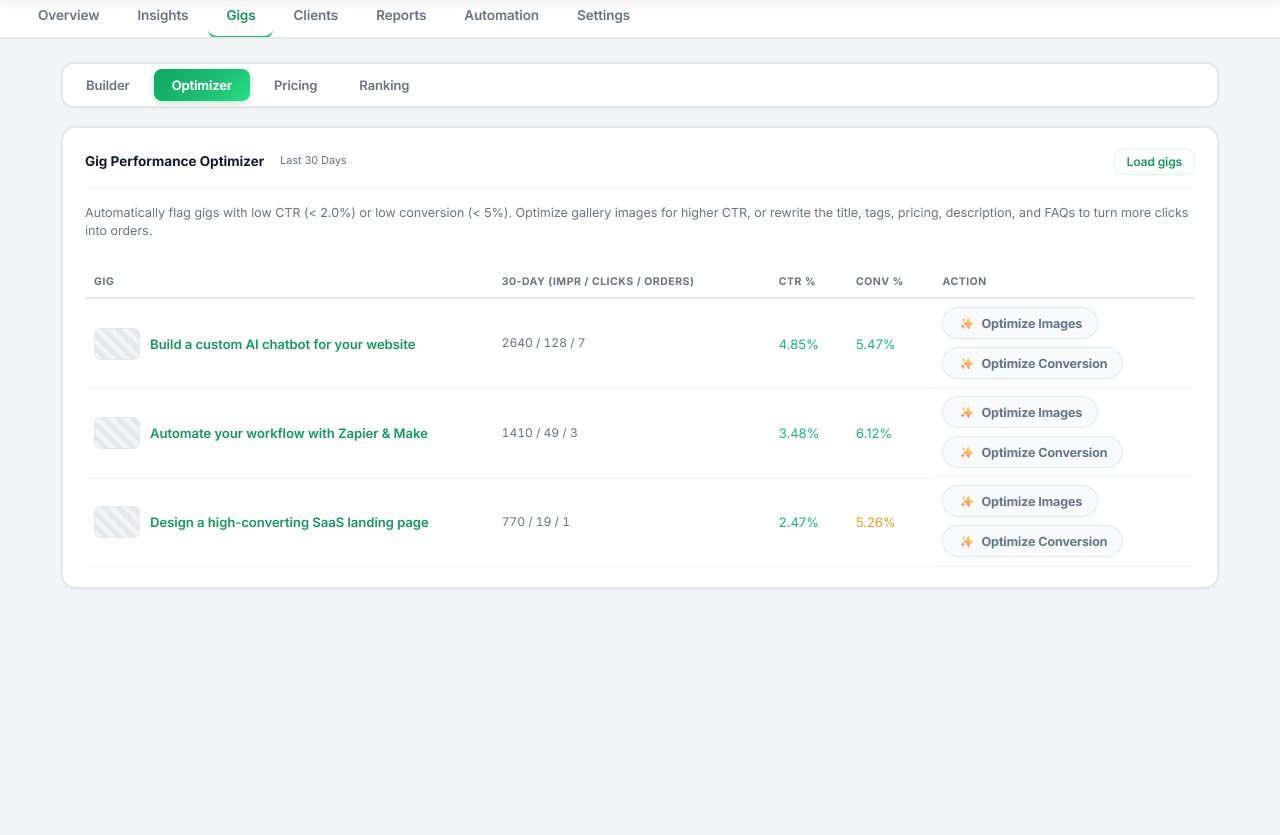
Seller OS covers the selling chores around repetitive data work. The Gig Performance Optimizer reviews a live gig's copy, gallery, and conversion signals against that gig's own performance data and proposes changes, while tracked keywords keep position history for each phrase you name in local storage. Inbox reply drafts turn a price question or a volume question into a reviewed draft you edit before sending.
Local client records hold each buyer's data type, volume bands, and delivery notes, so a repeat batch starts from your last mapping instead of a blank message. It does not do the entry itself, touch your client files, or send anything: it drafts and fills, and a person performs every final Send, Save, or Publish action.
Fiverr SEO for Data Entry Specialists questions
How do I rank a data entry gig on Fiverr?
Name the input and the output in your title, such as PDF to Excel or CRM cleanup, because that pair is what a buyer types. Keep close variants in the five keyword slots and five tags, put the detail in the description, and give each change at least 30 days before judging it, which is the window Fiverr's Advanced Analytics article recommends for new or updated keywords.
Should I offer general data entry or one data type?
Start with one data type you can demonstrate. A specific offer answers the buyer's first question in the title, gives you a matching sample, and makes quotes fast. You can mention adjacent work in the description, and once one gig has orders and reviews, a second listing can cover a different data type.
How do I prove accuracy without showing client data?
Publish your checking process instead of the data: describe the duplicate scan, completeness count, and spot check you run on every delivery, then show a sample table built from invented rows. Say clearly in the portfolio description that the values are fictional, and never reuse client records as an example, even after the order completes.
What should I limit before accepting a data entry order?
Fix four things in writing first: the record count or page count, the fields required per record, the number and format of source files, and the delivery window. State them in the package description and repeat them in your gig requirements, because volume disputes cause most of the revisions this category sees.
Pick one data type, then price it
Name the input and output in the title, publish your QA pass, and set volume bands a buyer can quote against.