 Seller OS
Fiverr rank recovery after a vacation
Coming back from a break is not the same problem as a gig that never ranked. When you set yourself unavailable, Fiverr states your gigs are temporarily removed from search, and they reappear when you become available again. Most of the return is a waiting game with a few signals you actually control.
This guide is the return plan: what tends to drop and recover on its own, the signals worth sending in your first week, how long to wait before you touch a gig field, and the habits that keep recovery slow. It picks up where the leaving advice ends, so the vacation mode guide covers the departure itself.
Free plan available. Local-first data. Human review on every change.
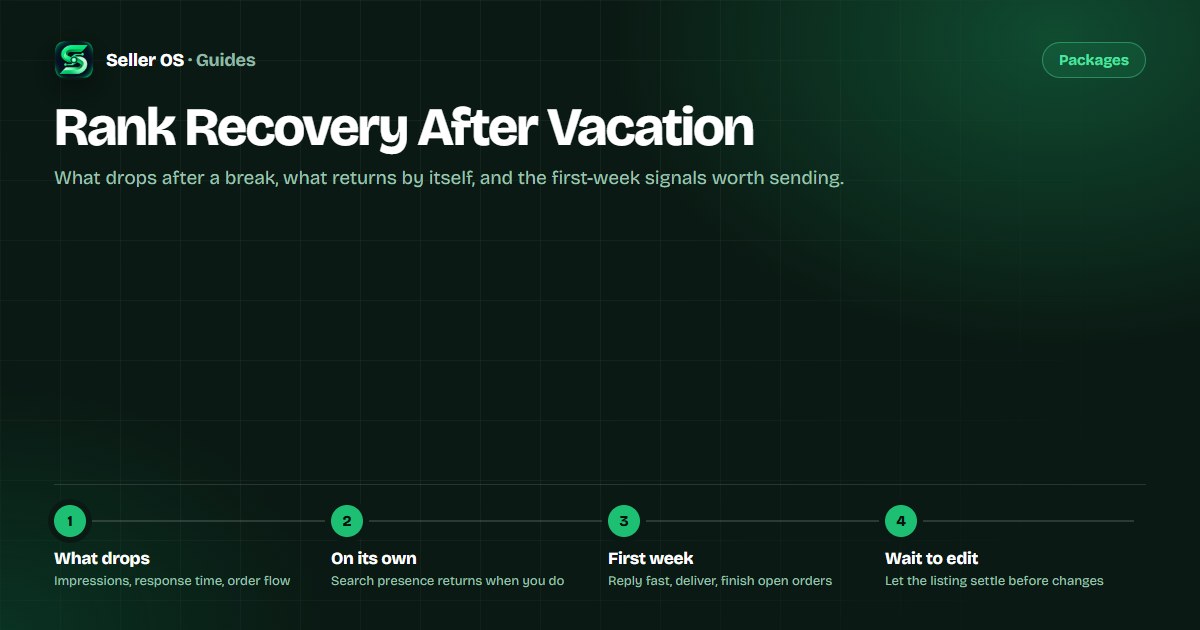
What a return from a break actually changes
Fiverr removes your gigs from search while you are unavailable and restores them when the range ends, as described on its Availability page. That part is automatic. What does not switch back instantly is the demand around the listing and the habits that feed it.
Expect three things to look soft in the first days. Impressions are quiet because the listing is finding its place again. Response time looks worse because an inbox that sat still now has a backlog. Order flow is slower because regular buyers may have moved on while you were gone. None of that is a ranking penalty; it is the ordinary gap between presence and momentum.
The gap closes on its own only if you keep feeding it. A listing that returns to a silent account stays quiet; a listing that returns to fast replies and completed orders picks the pace back up.
- Impressions: low at first, then they build as buyers find the listing again.
- Response time: measured from your first reply, so a slow backlog shows.
- Order flow: slow until a few completed orders refresh your recent history.
What recovers on its own
Search presence is the piece you do not have to rebuild. The published ranking caveat sits with the break, not the return: Fiverr states that setting Availability does not necessarily affect gig ranking, but if the unavailable period runs over 30 days within a 180-day window, ranking might be affected. If you were gone a long stretch, give the listing room to settle instead of reading the first week as a verdict.
Two metrics recover on their own only if you feed them. Response rate counts the share of first replies sent within 24 hours over the last 90 days, so a fast week pulls the number back toward normal. On-time delivery builds from completed orders, so every order finished on schedule adds to the record the score reads.
The signals to send in your first week back
You cannot force search to favor a listing, but you can show the platform and your buyers that the account is active and reliable again. The signals are simple, and they stack on top of each other.
Clear the inbox backlog
reply to every unread thread, oldest first.
Answer new first messages inside 24 hours
that is the published window that counts.
Deliver any in-flight order before its date
on-time delivery reads from completed orders.
Confirm your gigs are visible again
Availability reverts by itself, so verify it.
Take one small order if it fits
a completed order refreshes recent history fastest.
How long to wait before you edit a gig
The temptation on return is to rewrite titles, swap images, and rework tags all at once. Resist it for a week or two. A returning gig has fresh signals arriving; a burst of edits makes it impossible to tell whether a change helped or hurt.
When you do edit, change one field and read the result against the window before the change. If the numbers are climbing on their own, the correct next action is usually none.
| Window | Do | Avoid |
|---|---|---|
| Days 1-3 | Reply fast, deliver, check visibility | Rewriting the gig |
| Days 4-7 | Watch impressions and response time | Treating the week as final |
| Week 2 | Change one field if evidence supports it | Changing several at once |
| Weeks 3-4 | Read the trend against your pre-break baseline | Editing on a slow day |
Mistakes that keep recovery slow
The first mistake is reading a quiet week as a ranking punishment. Search takes time to route demand back to a listing that left the index, and the published caveat concerns the break, not your standing as a seller.
The second is mass-editing, which resets the comparison you need. The third is letting the inbox stay behind, because response rate is a first-reply metric and a pile of unanswered threads is the one return problem fully in your control.
The fourth is stepping away again immediately. A short second break teaches buyers the same lesson as the first, and it restarts the settle time before any of the numbers have recovered.
- Do not read a slow first week as a ranking drop.
- Do not change several gig fields in one pass.
- Do not let first replies age past 24 hours.
- Do not judge a trend from a single day.
A four-week return plan
A plan turns the return into a sequence instead of a mood. Week one is reactive: clear messages, deliver, confirm presence. Week two is observational: watch impressions and response time without editing. Week three is where a single evidenced change belongs. Week four is the read.
At the end of the month, compare the trend, not one day, against where you were before the break. If impressions are climbing and response rate is back above your level threshold, the return is working. If they are flat after four active weeks, the ranking dropped guide covers a deeper diagnosis, and the impressions triage handles a sudden overnight change.
Where Seller OS helps
A return is easier when the history you built before the break is still in front of you. Seller OS keeps tracked keyword history, gig summaries, and client records in Chrome local storage, so the pre-break baseline you compare against is a click away instead of a memory.
The honest limit matters here: the extension collects nothing while Chrome is closed, so a long break pauses the history too. Monitors run only while the browser is open, and every change it proposes waits for your Save or Continue. It reads and drafts; you decide what recovery requires.
Rank Recovery After Vacation questions
How long does a Fiverr gig take to recover after vacation?
Fiverr restores your gigs to search as soon as your unavailable period ends, so visibility returns immediately. Demand takes longer: impressions and order flow usually rebuild over two to four active weeks as buyers find the listing again. Fiverr also notes ranking is not necessarily affected unless unavailability runs over 30 days within a 180-day window.
Will my ranking drop after a Fiverr break?
Fiverr states that setting Availability does not necessarily affect gig ranking, but a break longer than 30 days inside a 180-day window might affect it. If your absence was shorter, treat a quiet first week as demand rebuilding rather than a penalty. Watch the trend across several weeks instead of judging a single day.
Should I edit my gig when I return to Fiverr?
Wait. Give the listing a week or two of normal activity first, then make one change and read the result against the window before the change. Editing several fields at once on return makes it impossible to tell what helped. If the numbers are climbing on their own, the right action is usually none.
What should I do first when coming back to Fiverr?
Clear the inbox, oldest thread first, and get every first reply inside 24 hours. Then deliver any order still in flight before its date and confirm your gigs are visible again. Those steps refresh the two records that matter most, response rate and on-time delivery, without touching a single gig field.
Return on a rhythm, not a panic.
Reply fast, deliver on time, confirm visibility, and let the listing settle before you edit.