 Seller OS
Can you use ChatGPT for Fiverr?
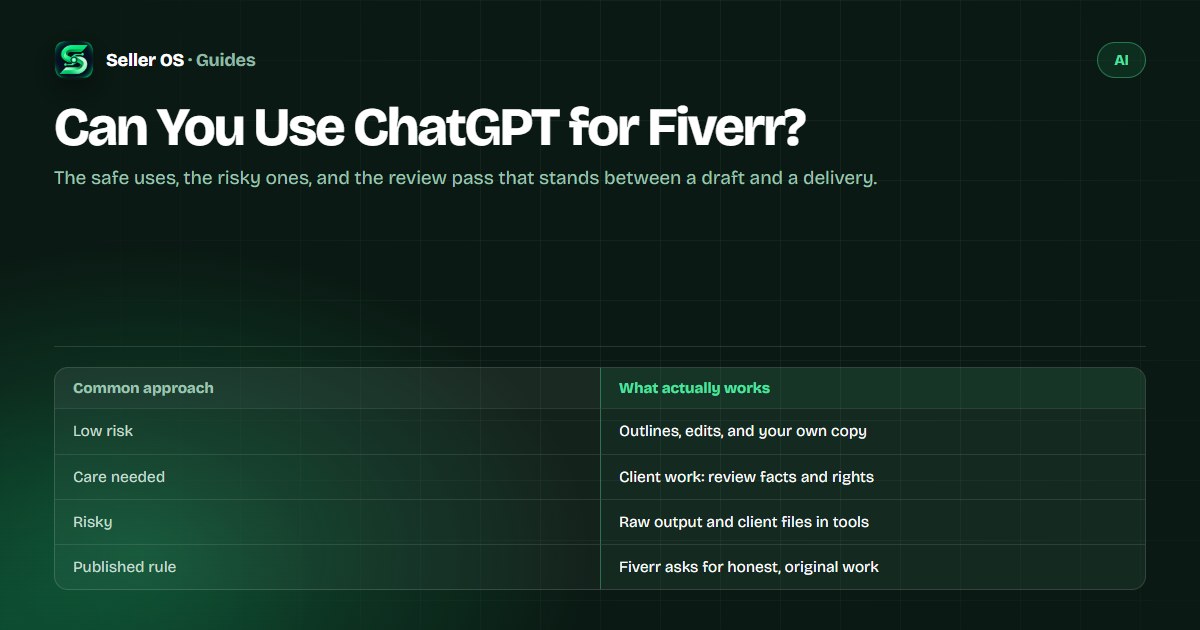
Fiverr does not publish a blanket ban on using ChatGPT, and its own products include AI features. The published expectations sit elsewhere: honest, original work, accurate answers, and client confidentiality. So the useful question is not whether you may use it, but which uses carry risk and what review separates a draft from a delivery.
This guide maps the low-risk uses, the genuinely risky ones, what Fiverr's published pages say about original work and client information, and a review pass you can run before anything ships. The honest limit: no guide can certify your output, and you remain responsible for what you deliver.
Free plan available. Local-first data. Human review on every change.
The short answer: allowed, not automatic
Yes, sellers use ChatGPT-style tools, and Fiverr does not publish a general ban on them. Fiverr's own platform ships AI features, including an AI creation model that eligible freelancers can train on their own assets. The question that matters is what you do with the output, because the published expectations are about honest, original work and accurate information rather than about the tool itself.
The practical line runs through the delivery. Drafting your own listing, planning a reply, or editing your writing carries little risk. Sending raw output as client work, uploading files you have no right to share, or claiming experience the model invented are the behaviors that can cost you the client, the review, or worse. Review is the difference, and it is the part only you can do.
What Fiverr publishes about AI and originality
Fiverr's public pages reviewed for this guide do not include an AI-detection rule or a statement that AI-assisted drafting is prohibited. What they do publish: profile guidance telling sellers to be honest and original and to keep contact and payment details out of the About section; a policy framework where violations of the Terms of Service or Community Standards can restrict an account; and its own AI products, such as the AI creation model for eligible freelancers and the Gig Summary feature.
Fiverr Go, the AI creation model published on help.fiverr.com (checked September 2026), is the clearest signal of how the platform treats generated work: it is opt-in, limited to eligible sellers and categories, trained on the freelancer's own assets, and clients generate watermarked drafts from it. When Fiverr builds AI into the marketplace this deliberately, the seller's takeaway is not to hide the tool but to control the output.
- No published blanket ban on AI drafting tools
- Profile guidance asks for honest, original, English-profile content
- Policy violations can restrict accounts under the published standards
- Fiverr operates its own gated AI features inside the marketplace
Where ChatGPT use is genuinely low-risk
The low-risk zone is anything where you are the author and the tool is a helper. Drafting your own gig copy, restructuring a description against a character limit, turning your notes into an outline, generating practice questions for a briefing call, rewriting a paragraph you wrote, or summarizing a public article you are studying all fit here.
A second low-risk pattern is preparation that never needs client detail at all: keyword clustering from a phrase list you gathered, title variants you will choose between, or a checklist you will follow. In each case a human wrote the inputs and a human approves the output, and nothing about a client is exposed. The same build-and-review logic applies when you use an AI gig builder for your own listing.
- Your own marketing copy, outlines, and edits
- Keyword and title candidates from your own research
- Practice, study, and planning artifacts
- Structure for messages you will rewrite and send yourself
Where the risk actually sits for sellers
Delivering raw output as finished client work is the first risk, not because a rule forbids it but because unreviewed work fails: invented facts, wrong names, off-brand tone, and material the client already rejected. The second is confidentiality. Uploading a client's brief, draft, or data to a tool whose handling you have not checked can breach the client's expectations even when no platform rule names it.
The third is misrepresentation: generated experience, fabricated results, or a style you cannot reproduce when revisions arrive. The fourth is automation, where the published rules do bite. Fiverr says automatic responses are not counted as a response, and it states that freelancers cannot initiate contact with new clients, so a tool that messages on your behalf is working against the platform's design.
| Use | Risk | Why |
|---|---|---|
| Editing your own draft copy | Low | You own the facts and the voice |
| Drafting a reply you then rewrite | Low | A human reviews before send |
| Generating client deliverables unedited | High | Errors and tone fail at delivery |
| Uploading client files to unknown tools | High | Confidentiality is the client's call |
| Auto-sending messages | High | Automatic replies do not count; contact rules apply |
A worked review pass, start to finish
Hypothetical: a buyer orders a 900-word blog post, and you use a model to draft from their outline. The draft arrives polished. In it, the model has inserted a statistic: 'studies show 73% of buyers prefer X.' You cannot source the number, so the line goes and gets replaced with a claim you can support from the outline or the client's own materials.
Next, the copy check. One sentence reads suspiciously close to a competitor page the model may have absorbed, so you rewrite it in your own words and note the source of every factual claim. Then the client-data pass: the prompt contained the client's name in the header, which you remove before sharing the document. Three passes, five minutes, and the delivery is yours again. Message drafting follows the same pattern in the AI buyer-reply guide and the brief-response workflow.
The delivery standard to hold yourself to
Before anything ships, run the same four checks: facts you can source, names and dates that match the order, a voice consistent with what the buyer approved, and permissions for any asset you did not create. If the client's instructions mention disclosure, follow them plainly. If platform policies limit the work itself, those limits win over convenience.
Then ask the only question that matters: would you defend this delivery if the buyer asked how it was made? A yes is the standard. ChatGPT can be part of the process; it cannot be the answer to that question. You remain the author of what you deliver, which is exactly what Fiverr's published expectations assume.
- Source every fact, or cut it
- Match every name and date to the order
- Check the rights on every asset you did not create
- Follow the client's disclosure rules when they exist
Where Seller OS helps
Seller OS is built around the review pass this guide describes. Drafts for gig copy, buyer replies, and brief responses arrive with the original context beside them, and a person approves every one before it goes anywhere. Gig audits flag claims and copy that drifted, and client records keep project facts local rather than scattered across chat tools.
The limits are stated plainly: the extension does not claim AI output is undetectable, does not make originality decisions for you, and never sends or publishes on its own. It runs with your own AI provider account or an eligible browser session, and it does not include AI credits. The judgment stays yours, where it belongs.
Can You Use ChatGPT for Fiverr? questions
Can I use ChatGPT for Fiverr gigs?
Fiverr does not publish a general ban on AI drafting tools, and its own platform includes AI features. The safe pattern is human-led: you set the facts, the tool helps with structure and phrasing, and you review everything before it reaches a buyer. The risky patterns are raw output, invented claims, and uploading client material.
Do I have to disclose that I used AI?
Fiverr's reviewed pages do not publish a blanket disclosure requirement; what they emphasize is honest, original work. The client's own expectations decide. If their brief requires original human work or asks about tools, answer plainly and follow it. When the rules are unclear for a specific project, ask the client before delivery.
What should never go into a ChatGPT prompt?
Client files, personal details, order information, and anything you would not be comfortable seeing outside the project. Even if a provider's terms are generous, the client's confidentiality expectations come first. Paraphrase the request if you need drafting help, and keep the deliverable's identifying details on your own machine.
Is AI content detectable on Fiverr?
No tool or guide can honestly promise that. No Fiverr page reviewed for this guide states a detection rule, and detection tools themselves are not a reliable standard. The practical standard is not invisibility; it is quality you can defend, with facts you can source, a voice you own, and a delivery the buyer would approve.
Use the tool, own the delivery
Keep the work human-led, run the review pass, and deliver only what you can defend.