 Seller OS
Fiverr terms of service 2026: what changed
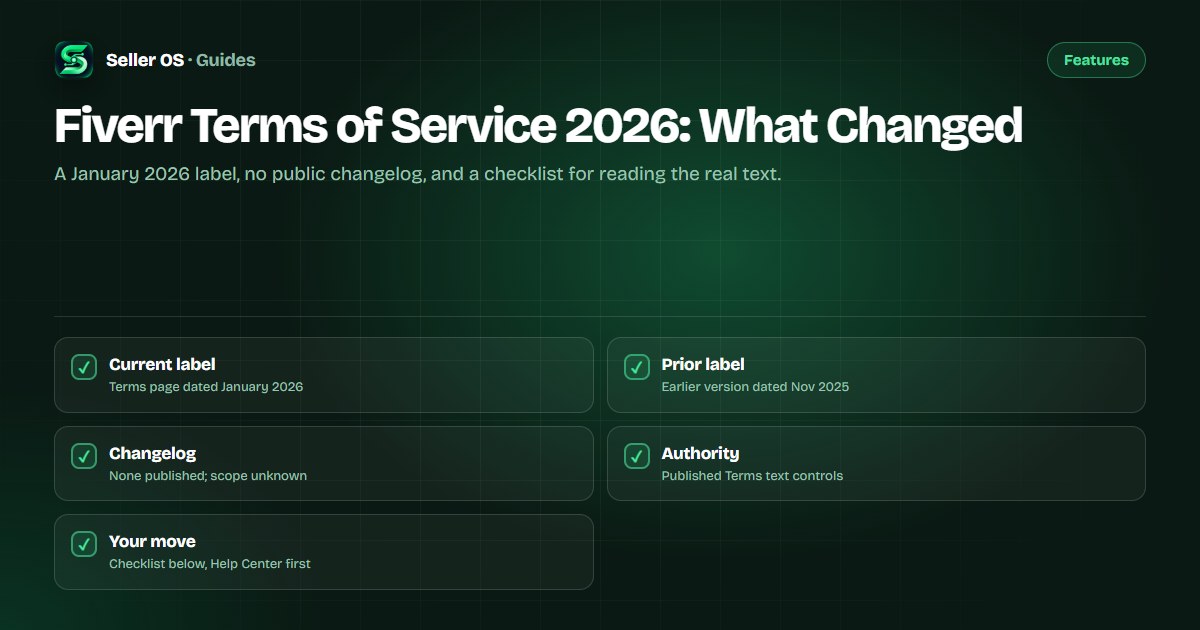
The current Terms of Service page is labeled Last update January 2026, while a January 2026 archived capture of the prior page renders a November 2025 header. No public changelog documents what changed between those labels, and the archived copy exposed only the header, so a clause-level comparison was not possible.
This guide states only what is verifiable about the update, shows where the authoritative text lives, and gives you a seller-relevant reading checklist. This is general information only, not legal advice; the published Terms are the authority.
Free plan available. Local-first data. Human review on every change.
What verifiably changed in January 2026
Only the date label itself is verifiable: the live page reads Last update January 2026 and the prior published version read November 2025. Fiverr published no changelog and no announcement describing the substance, so any article claiming a specific clause was added or removed in that update is guessing rather than reporting.
A common mistake sellers make is quoting third-party summaries of the update as though they were the Terms. Treat every specific claim about January 2026 scope as unverified until you read the corresponding section of the live page yourself at the Terms of Service address.
Where the authoritative text lives
The Terms of Service page at the legal portal is the binding text, and the separate Payment Terms page carries its own Last update label, September 2026 as checked. When guidance links you to a summary, follow through to these pages before acting, since summaries age and the portal pages are what enforcement references.
Bookmark both pages plus the Help Center articles for the topics you touch most: non-circumvention, feedback rights, hourly contracts, and content moderation appeals. If a client or forum post asserts a rule, your answer should begin with what the portal page states, not what the thread claims, and you should recheck the live page whenever months have passed since your last read.
A seller-relevant map of the document
The current Terms structure includes sections sellers encounter directly, among them seller features such as custom offers, milestones, and subscriptions, non-circumvention and non-solicitation rules, the recommendation system description, hourly contract terms, content moderation notices and appeals, feedback rights, machine translation, and disputes handling. Read the sections that govern work you actually perform, and skim the rest only for awareness of where boundaries sit.
Illustrative scenario: a seller offering milestone orders reads the milestones and payment terms before quoting a five-stage project, while a seller doing hourly work reads the hourly contract terms first. General information only: this map orients your reading and does not interpret any clause for your situation.
| If you do this | Read this area first | Why |
|---|---|---|
| Custom or milestone orders | Seller features, payment terms | Stages, charges, and payouts |
| Client contact off order | Non-circumvention section | Contact and payment boundaries |
| Hourly contracts | Hourly contract terms | Logging, billing, and disputes |
| A review or moderation notice | Feedback and appeals areas | Rights and response paths |
Practical checklist to stay compliant
Work through one section per sitting rather than skimming the whole document once. Confirm your gig copy, profile claims, review requests, and off-platform contact habits each match the corresponding published section, and fix the first mismatch before hunting for more. Most sellers find two or three small wording fixes in message templates that remove needless policy exposure.
Keep evidence of your reading: save the date you reviewed each section and note the questions you could not resolve. Those notes become the exact questions for the warning system guide and the new-seller violations guide instead of vague anxiety about hidden rules that may not even apply to your category.
Open the live Terms page and confirm the date label you see today.
Read the sections covering work you actually sell, plus feedback rights.
Compare your gig, profile, and message templates against those sections.
Fix one mismatch fully before moving to the next section.
Recheck Payment Terms, dated separately, for payout-affecting terms.
What this guide does not claim
This guide does not state that any particular clause changed in January 2026, does not summarize the update as stricter or looser, and does not advise you on how a clause applies to your account. Those limits are deliberate: without a published comparison, scope claims would be invented, and interpretation of legal text for a specific situation belongs to qualified counsel, not a seller guide.
Illustrative example: two sellers read the same circumvention section and reach different conclusions about sharing a portfolio link. The correct next step for both is identical, which is reading the Help Center explanation and asking support about the specific fact pattern, not treating this article as a ruling.
Moments when re-reading pays off
Re-read the relevant section before launching subscriptions, milestones, or hourly offers, before changing how you request reviews, and after any warning or moderation notice. Those are the moments when the distance between your habit and the published text turns into account consequences rather than harmless drift.
If contact rules confuse you, the contact-sharing guide explains the published boundary in plain terms. For account structures, pair this page with the multiple accounts rule so the entity holding the obligations is as clear as the obligations themselves.
Where Seller OS helps
Seller OS keeps your side of compliance tidy: local client records with notes and history, message drafts you review before sending, and a short action queue that surfaces what needs attention. That record helps you answer precisely if support ever asks what was agreed, without digging through scattered threads.
It does not interpret the Terms, monitor your compliance, or give legal advice. A person performs every final Send, Save, Continue, or Publish, and the published Terms plus the Help Center remain the only authorities on what those actions must satisfy.
Fiverr Terms of Service 2026 questions
What changed in the Fiverr Terms of Service in January 2026?
Only the date label is verifiable: the live page reads Last update January 2026 and the prior version read November 2025. No public changelog describes the substance, and the archived prior copy exposed only its header. Do not rely on any article claiming specific clauses changed; read the current published section that governs your situation.
Where do I read the current Fiverr Terms?
On the legal portal Terms of Service page, which is the authoritative text, plus the separate Payment Terms page carrying its own update label. Start from those pages rather than summaries. This guide is general information only and never legal advice; the portal text controls, and qualified counsel is the right source for interpretation.
Does the January 2026 update change what sellers must do?
No specific new seller obligation can be attributed to that update without a published comparison. The practical move is reading the sections that cover your work: seller features, non-circumvention, hourly terms, feedback rights, and appeals. Fix any mismatch between your habits and the live text, beginning with review requests and off-platform contact.
How do I stay compliant without reading everything weekly?
Read the sections you actually use, re-read before adding milestones, subscriptions, or hourly offers, and re-read after any warning or moderation notice. Keep dated notes on what you reviewed and which questions stayed open. Use those notes to ask support precise questions instead of carrying vague worry about hidden rule changes.
Read the page, check your habits
Open the live Terms, read your sections, and fix one mismatch at a time.