 Seller OS
Fiverr promoted gigs ROI: when paid clicks lose money
Promoted Gigs puts your listing in front of more buyers, but every click costs money whether or not it turns into an order. That makes paid promotion a math problem first and a marketing tactic second. This guide gives you the break-even formula, a worked example with the losing point marked, and the situations where promotion usually loses money.
It is not a setup walkthrough. For campaign settings, read the ads explainer, and for tuning live campaigns, read the optimization guide. Here you decide whether the numbers support spending at all.
Free plan available. Local-first data. Human review on every change.
How Fiverr charges for promoted gigs
Promoted Gigs is Fiverr's pay-per-click advertising for gig listings. Fiverr's Help Center describes the model: you set a daily budget cap, your gig can appear in promoted placements in search results, and you pay only when a buyer clicks. Impressions alone cost nothing.
Two consequences follow. First, clicks from curious buyers cost the same as clicks from serious ones, so targeting and the gig page share the bill. Second, the daily cap bounds your spend but not your cost per order; that number is decided by your conversion rate, which advertising cannot fix.
- You set the daily budget cap; spend never passes it.
- You pay per click, not per impression or per order.
- Promoted placement adds visibility; the gig page still has to convert.
The break-even formula in three numbers
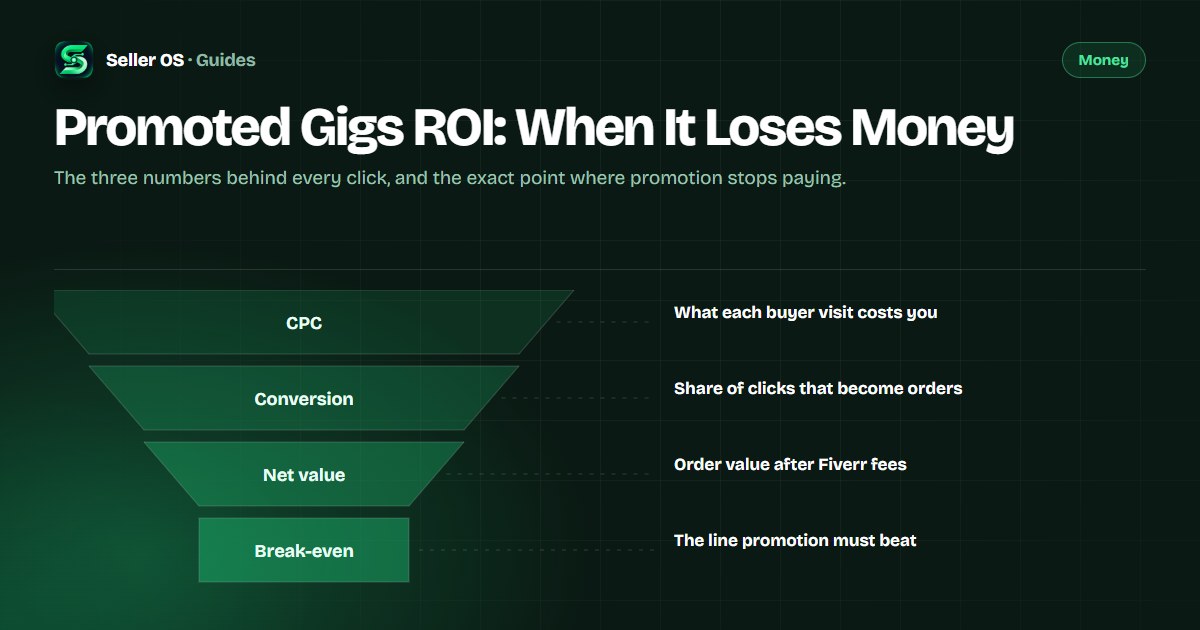
Three numbers decide whether promotion pays: average cost per click, the share of clicks that become orders, and your net earnings per order after Fiverr's fees. Cost per order equals cost per click divided by conversion rate. Promotion pays only when your net per order sits above that cost.
Fill in your own figures before you spend. Use last month's numbers if the gig already gets traffic. If the gig is new, borrow a conversion rate from a similar gig or from the conversion-rate guide, and treat the result as a rough estimate rather than a promise.
| Input | What it is | Where to find it |
|---|---|---|
| Cost per click | What one visitor costs | Your campaign report or a small test |
| Conversion rate | Clicks that become orders | Gig analytics or the conversion guide |
| Net per order | Order value minus Fiverr fees | The fee calculator |
A worked example, with the losing point marked
The numbers below are illustrative assumptions, not Fiverr-published averages. They show the method so you can repeat it with your own figures. Assume a $0.90 cost per click, a 2% click-to-order rate, and a $50 order. One hundred clicks cost $90 and produce about two orders worth $100 before fees.
After Fiverr's commission, those two orders net roughly $80, so check live figures with the fee calculator. You spent $90 to earn $80, which means the campaign loses about $10 per hundred clicks. The losing point is exact: at $0.90 per click and $40 net per order, you need a conversion rate above 2.25% (0.90 divided by 40) to break even. Anything below that loses money on every click.
Four situations where promotion usually loses money
Some gigs fail the formula before a single click is bought. Low-priced gigs are the clearest case: a small order nets only a few dollars after fees, so even cheap clicks need an unusually high conversion rate to pay back. Promotion multiplies traffic; it cannot multiply order value.
- Low order values: the net per order cannot cover the cost per click at a realistic conversion rate.
- Weak gig pages: few reviews, vague packages, or a thin gallery turn paid clicks into bounces.
- Broad targeting: clicks from buyers who wanted something adjacent cost the same and convert rarely.
- Brand-new gigs with no proof: paid visits arrive before trust signals exist, so most of them leave.
What to fix before you raise the budget
Run promotion only after the gig converts organic visits. Earn a few reviews first, tighten the gallery and packages, and confirm the click-to-order rate in gig analytics. A small daily cap then works as a test: if the test week fails the formula, pause and repair the page instead of raising the cap.
If the math never closes, organic demand is the better channel. The ads-versus-organic comparison lays out when each earns its place, and most new sellers grow faster by publishing a second gig than by funding clicks to the first.
Where Seller OS helps
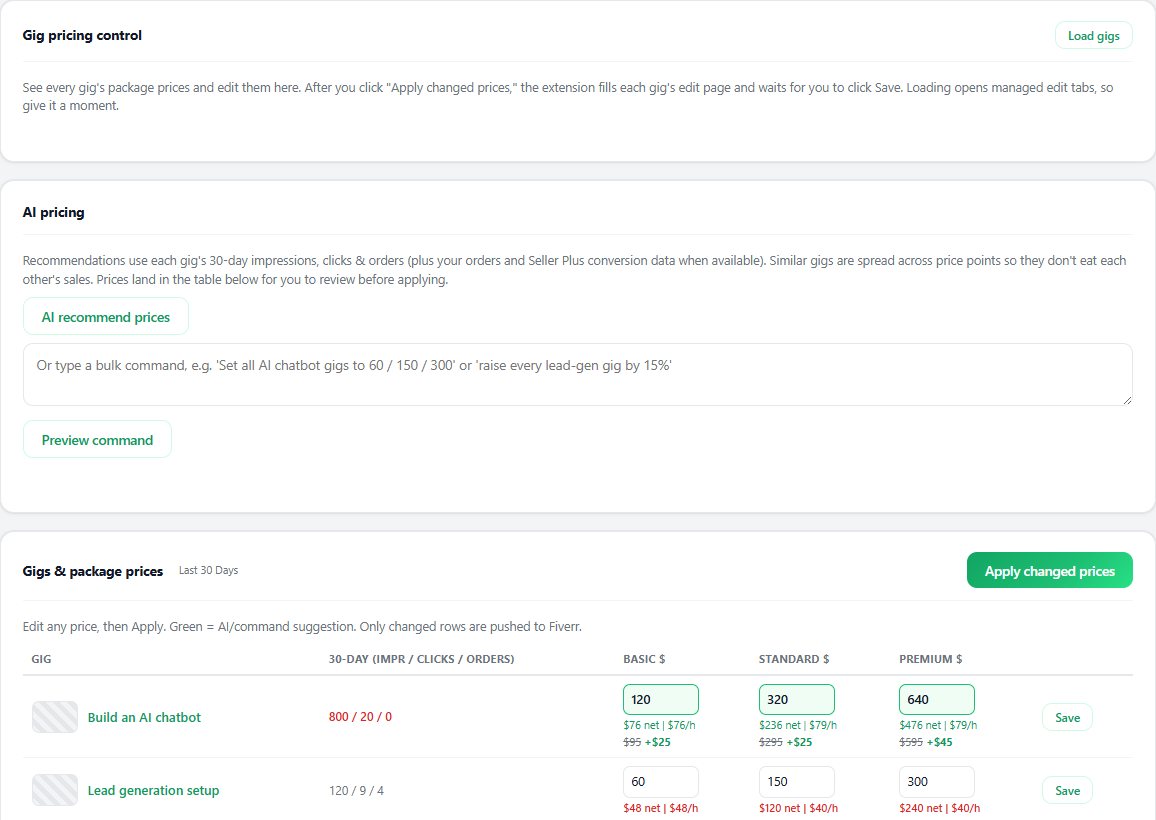
Seller OS cannot buy clicks for you, and that boundary keeps the math honest. The pricing workspace helps you see net per order after fees, and the gig optimizer reviews a live gig's copy, gallery, and conversion signals against the gig's own performance data before you spend anything on promotion.
Everything stays local and review-gated. Client records and order history live in Chrome local storage, drafts are filled into Fiverr pages for your review, and a person completes every Save, Continue, or Publish action. The extension never publishes or purchases anything on its own.
Promoted Gigs ROI questions
How do I know if Promoted Gigs is profitable for me?
Divide your average cost per click by your click-to-order conversion rate to get your cost per order. Compare that number with your net earnings per order after Fiverr fees, using the fee calculator for live figures. If the cost per order is lower, promotion can pay. If it is higher, every extra click deepens the loss. Recompute monthly.
Why does my promoted gig get clicks but no orders?
Paid placement buys visits, not trust. Most click-without-order patterns trace back to the gig page: too few reviews, a gallery that does not show the deliverable, packages that blur together, or a price the proof does not support. Pause the campaign, fix one element at a time using the conversion-rate guide, and restart with a small daily cap once organic visits start converting.
Should a new seller with no reviews use Promoted Gigs?
Usually not yet. Without reviews, a portfolio, or order history, your conversion rate is at its lowest, which is exactly when paid clicks cost the most per order. Earn the first reviews through organic visits and buyer requests first, then test promotion with a small daily cap. The traffic guide for new gigs gives the order of operations.
Do I still pay Fiverr fees on orders from promoted gigs?
Yes. The advertising cost and the marketplace commission are separate charges. Fiverr deducts its standard commission from the order value as described in the Help Center, and the click spend comes out of your daily budget on top of that. Always subtract both when you compute profit, because campaigns that look profitable before fees often fail after them.
Run the math before you spend.
One formula decides if promotion pays; use it before raising your daily cap.