 Seller OS
Buying a Fiverr account: why it ends in a ban
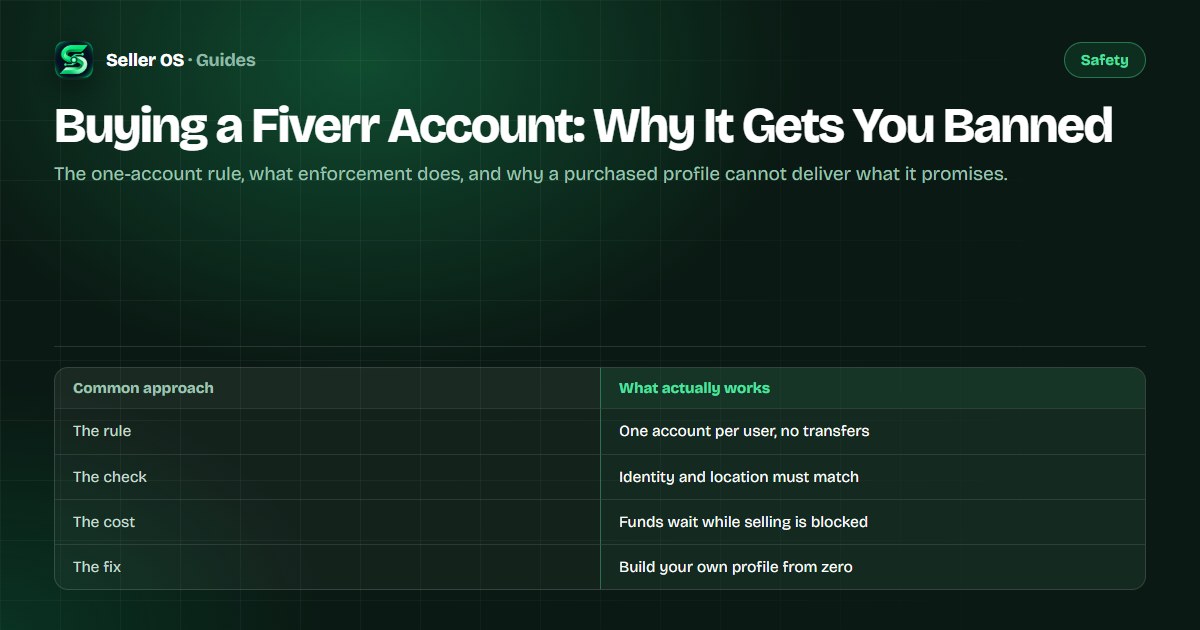
Fiverr's published rule is short: users can only have one account on the platform, because multiple accounts can be misleading to other users and are considered manipulation of the system. Buying an account does not transfer a business to you. It puts someone else's identity record in your hands.
This guide explains what enforcement does to bought accounts, why identity and location checks break the handover, where the funds and reviews actually sit, and how to build a profile of your own instead. It never names or links the sellers behind these listings, and it does not describe evasion tactics.
Free plan available. Local-first data. Human review on every change.
The one-account rule and account integrity
Fiverr's enforcement page describes the account integrity violation directly: users can only have one account on the platform, as multiple accounts can be misleading to other users and are considered a manipulation of our system. A bought account is not a gray area. It is one person operating a record built by another, which is the pattern the rule names.
The Ineligible to Sell list names what follows from that: offering prohibited services, operating multiple accounts, using methods to hide your online identity or location, or engaging in activities previously associated with fraudulent behavior. The published consequence is specific: you cannot offer services, though you can complete active orders and keep using Fiverr as a client. Depending on severity, enforcement can also remove content or permanently suspend the account.
What enforcement does when it lands
Fiverr's ladder moves from warnings to restriction to suspension. Warnings arrive by email, expire after 90 days, and can affect your status in the level system. An account may be permanently suspended after two warnings for the same violation, three warnings for different violations, or a severe breach of policy. Account owners cannot log into suspended accounts.
Restriction is the intermediate step: during the 60 days that follow, the user can still communicate with existing clients through the active order page and withdraw available or pending clearance funds. After that period, the account is permanently suspended. Suspended freelancers wait 90 days to withdraw and get limited access to complete open orders. The restricted account guide walks through what still works in that window.
A scenario worth playing out: a seller buys a profile described as Level 2 with orders and reviews. Months later, a review flags an unusual location pattern. The account is restricted, the 60-day window starts, and after it the account is permanently suspended. The purchase took the profile, the money timing, and the reviews with it.
Why bought accounts fail verification
Fiverr routinely requires freelancers to verify their identity, typically with an official government ID, and the step is tied to the person on the account. Only original physical documents are accepted, a third-party provider compares the ID with a live selfie, and there is a 14-day window to finish. Failing removes the ability to sell.
A handover cannot move that verified identity. You are not the person on the ID, and you cannot pass a liveness check as them. On top of that, Fiverr's published enforcement language names unusual location patterns and methods to hide your online identity or location as integrity problems, so a new person signing in from somewhere else is the visible edge of the risk.
Verification failure is not the only break point. Payout details, device history, and account behavior all belong to the record, and the seller who built that history may still hold recovery access. Buying an account means trusting a stranger's promises about all of it at once.
Where the money and reviews really sit
Neither the balance nor the reputation becomes yours. During a restriction, funds can be withdrawn while the 60-day window runs; after a suspension, Fiverr states the balance stays in the account but can be withdrawn after 90 days. In practice, that means your money can sit inaccessible in a record you no longer control. The banned funds guide covers the withdrawal rules in more detail.
Reviews work the same way. They are attached to the account record, not to you, so a suspension takes the profile and the history together. A new account starts from zero, and Fiverr's troubleshooting guide states that creating a new account after yours has been disabled is not allowed. That is the published position, and it is the opposite of a shortcut.
Pitch patterns and mistakes buyers make
The listings share a grammar: an aged profile with reviews, a verified badge claim, a handover that includes email and phone access, and a price that suggests urgency. Some pitch escrow or crypto payment; some offer to handle the identity step for you, which is itself a violation rather than a feature. None of those descriptions change what the platform rules say about the handover.
The mistakes stack up on the buyer's side. Paying with an irreversible method, sharing your own ID with a stranger to complete a transfer, believing the seller has really deleted their recovery access, and treating the account's reviews as an asset you now own are all versions of the same error. Each one trades a real identity risk for a reputation you cannot keep.
A profile built in your own name
The legitimate path is the slow one: create your own account in your own legal identity, complete verification through Fiverr's official flow, publish gigs you can deliver, and earn reviews order by order. It is slower than a purchase and it is the only version where the history actually belongs to you. The multiple accounts guide covers why sideways moves like a second login create more risk, not less.
If you already bought one, stop investing in it. If the account is disabled, the published path is an appeal through Customer Support; the appeal guide explains how to prepare one, and the disabled account guide covers what access looks like while you wait. No one can promise restoration, and creating a new account after being disabled is not allowed.
Where Seller OS helps
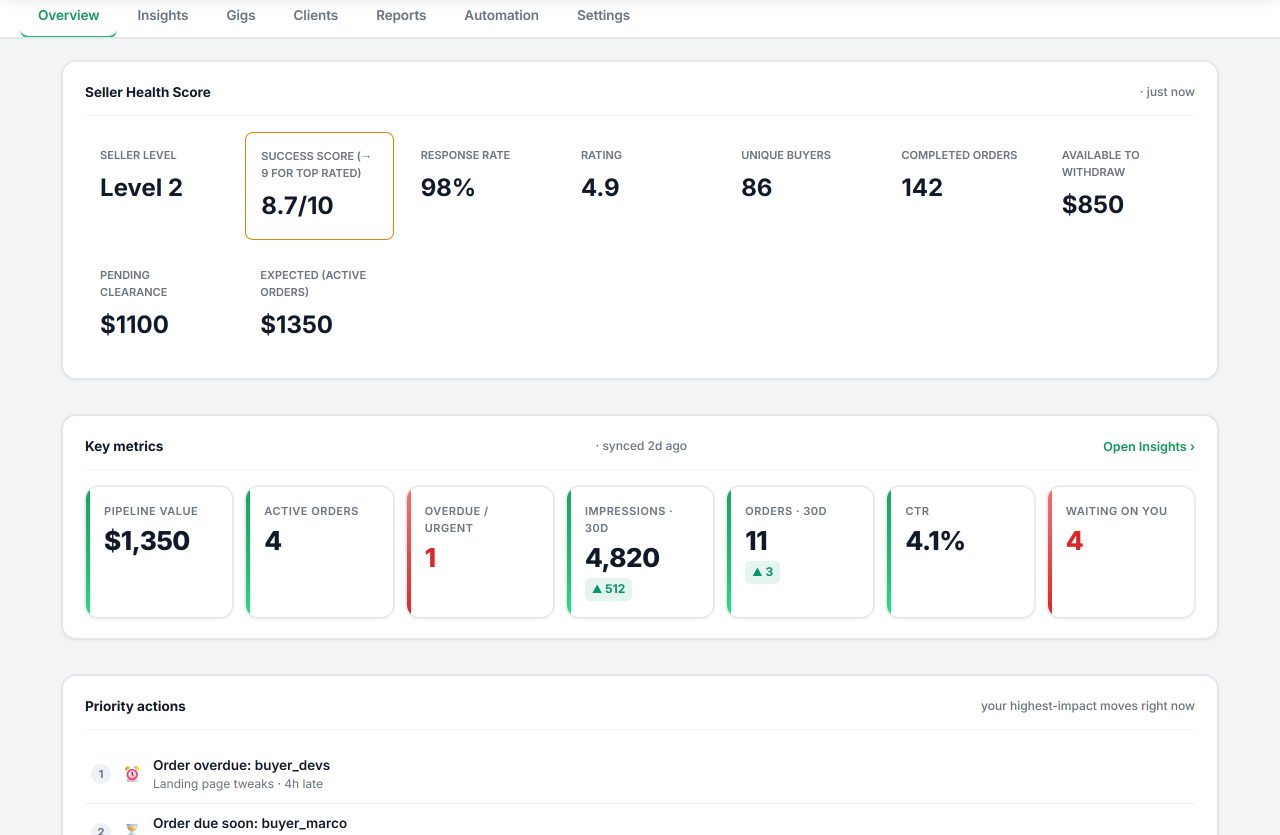
Seller OS is built for profiles you own. It keeps order history, client records, and notes in Chrome local storage, drafts inbox replies and briefs you review, and supports gig work through the Gig Builder and the Gig Performance Optimizer.
It cannot transfer, restore, or launder an account, and it never handles verification or account purchases. It drafts and fills; a person performs every final Send, Save, Continue, or Publish action. Start with the free plan; Pro is $12 monthly or $99 one time.
Buying a Fiverr Account questions
Is buying a Fiverr account safe?
No. Fiverr's account integrity rule allows only one account per user and treats multiple accounts as manipulation. A bought profile is tied to someone else's identity, so verification, location checks, and the account's history all work against you. Enforcement can restrict or permanently suspend the account, and the funds and reviews stay with it.
Can I sell my Fiverr account to someone else?
No. Accounts are tied to one user under Fiverr's one-account rule, and a handover is exactly the arrangement the rule forbids. Both sides take on account integrity risk. Fiverr's enforcement page also states that account owners cannot log into suspended accounts, so a sale does not protect the account from enforcement.
What happens to funds in a suspended Fiverr account?
Fiverr's published rules say the balance stays in the account, with withdrawal available after 90 days for suspended freelancers, and restricted accounts can withdraw available or pending clearance funds during the 60-day window before permanent suspension. Selling is blocked either way, so the money is not a reason to buy an account.
Do reviews transfer if I buy an account?
The reviews sit with the account record, not with you. If enforcement suspends the account, the profile and its history go with it, and Fiverr states that creating a new account after being disabled is not allowed. A fresh account starts with zero reviews, which is the honest starting point for every legitimate seller.
Build a profile that is yours
Only an account tied to your own identity keeps its history, its funds, and its future.