 Seller OS
Can you sell AI-generated content on Fiverr?
Yes, Fiverr allows sellers to use AI, and its own published guidelines say so directly. The permission comes with conditions: the tool has to support your own skill, you remain fully accountable for the final work, and generic, unmodified output does not meet the platform's quality standards. The rules page is short; the judgment calls are not.
This guide walks through what Fiverr publishes, the prohibited uses, what disputes weigh, and a draft-review-deliver workflow that keeps the work defensible. The honest limit: no policy can certify your output, and the final quality call stays with you.
Free plan available. Local-first data. Human review on every change.
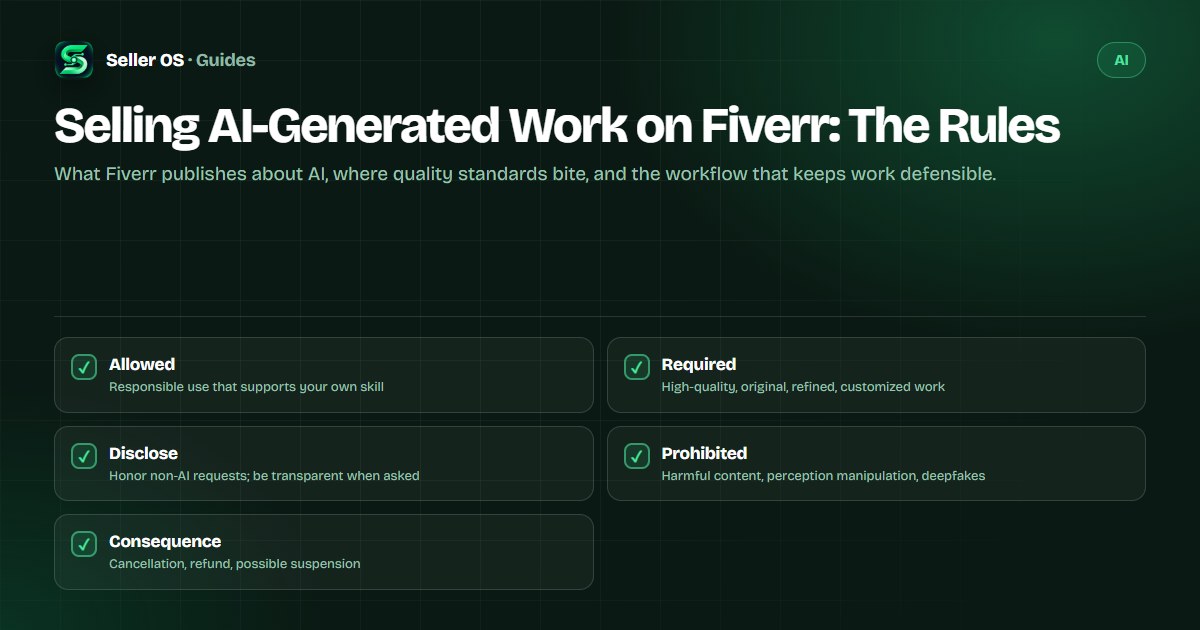
What Fiverr's published AI position says
Fiverr's guidelines for freelancers state that AI use is allowed when it is responsible, appropriate for the service being provided, compliant with laws and platform standards, and used to support the freelancer's own skill and effort rather than replace them. That is the permission, and it is conditional: the tool can assist, but you remain the author of record.
The same guidelines state that freelancers are fully accountable for the final work they deliver. Read together, those sentences settle most arguments before they start. You may use the tool; you cannot hand its output to a client and call the job finished, and you cannot present work as independently created when it is not.
A quick example helps. Outlining a blog post with a model, then writing, fact-checking, and restructuring it yourself, sits inside the permission. Pasting the model's draft into the order page and closing the order does not, because the published standard asks for meaningful refinement, not delivery of raw output.
The quality standard your delivery must meet
The published standard is specific: any AI-generated or AI-assisted work must be high-quality, original, and meaningfully refined and customized to the client's requirements. Fiverr adds that generic, unmodified, or reused AI output does not meet its quality standards. Refined, customized, and original are the words that decide close cases.
In practice, refined means you edited the structure, tone, and accuracy. Customized means the delivery answers this client's brief, not a generic version of the topic. Original means you are not reselling the same synthetic output across orders, and it means you are not reproducing someone else's protected work. The AI guidelines page places the accountability on the freelancer.
- High-quality: accurate, polished, ready to use
- Original: not reused or copied from other sources
- Refined: your edits and judgment, not raw output
- Customized: built for one client's specific brief
Non-AI requests and when to disclose
Fiverr's guidelines state that freelancers must honor an explicit client request for non-AI work. When a client specifies that preference, before or at the start of an order, you are expected to disclose your intended workflow and align with it. The trigger is the client's request, not your own comfort level with the topic.
Fiverr also encourages sellers to ask about client preferences during the order discussion and to stay transparent when AI use might affect the creative direction or the output style. Plain translation: if the brief says no AI, leave the tool out entirely, even for drafts. If the client asks whether you used AI, answer honestly.
The common mistake is treating a no-AI instruction as a preference to negotiate after delivery. It is not. A buyer who asked for human-made work and received model output has a genuine dispute, and the published dispute factors will not favor a freelancer who ignored an explicit instruction and never communicated about it.
Prohibited uses and dispute consequences
The prohibited list is short and serious: harmful or inappropriate content; using AI to create or alter images, videos, or content in a way that distorts reality or influences public opinion under false pretenses; deepfakes and non-consensual manipulated content; impersonation; and any use that conceals deception about what is real or independently created.
Service-level rules add specifics. Voice work requires explicit permission or rights for the vocal recordings involved, and AI avatar and image services must respect image and likeness rights. If a gig concept depends on a real person's face or voice, settle the rights question before the creative one.
Consequences follow the trust question. Fiverr states that a trust breach, including deception about how work was delivered or misrepresentation of AI usage, can lead to order cancellation, a full refund for the client, and possible permanent suspension of the freelancer's account. Those are platform decisions, not points to argue after delivery.
A practical draft, refine, deliver workflow
Use AI as draft support, not as the delivery. Generate structure, options, or a first pass, then rewrite until the voice and the facts are yours. Check every name, number, quote, and claim against a source you could show a client if they asked, and cut anything you cannot source.
Keep notes while you work: which tool you used, what you provided, and how the final version differs from the first draft. Tool licenses matter as well, because free tiers sometimes grant the vendor broad rights to inputs and outputs, and client material may not belong in those accounts at all.
Draft
generate structure or a first pass only
Verify
source or cut every factual claim
Rewrite
make the voice, examples, and flow your own
Customize
match the brief, brand, and audience
Record
keep tool, license, and edit notes on file
If a buyer accuses you of using AI
Stay factual and calm. Thank the buyer for raising it, ask which part triggered the concern, and answer with your process: the outline you built, the drafts you rewrote, the sources you checked. If the real issue is quality rather than the tool, offer a revision through the order page rather than arguing about detection.
Two mistakes make this worse. Getting defensive and refusing to engage turns a quality question into a trust question, which is the ground where consequences are harshest. Deleting drafts or edit history removes the evidence that shows your own effort and meaningful input, which is exactly what Fiverr says disputes consider.
When the revision conversation turns into a stream of generic or contradictory notes, the buyer-revisions workflow covers how to separate legitimate critique from noise and where to draw scope lines. For policy questions, keep answers short and tie them to the published guidelines.
Where Seller OS helps
The policy puts the review burden on you, so that is where Seller OS leans. Reply drafts, brief responses, and gig copy arrive with the source context attached, and nothing moves until you approve it. Gig audits flag claims and phrasing that drifted from the brief, and client details are kept in local records instead of pasted across tab after tab.
Its boundary matters here. The extension cannot decide whether work is original or refined enough, and it does not promise that any output will pass a review. It runs on your own AI provider account or an eligible browser session, includes no AI credits, and leaves every final action, including Send and Publish, to you.
Selling AI-Generated Work on Fiverr questions
Can you sell AI-generated content on Fiverr?
Yes, with conditions. Fiverr allows responsible AI use that supports your own skill and effort, but you remain fully accountable for the final work. Output must be high-quality, original, and meaningfully refined and customized to the client's brief. Generic, unmodified output does not meet the published quality standard, and you must honor any explicit non-AI request.
Do I have to tell buyers I used AI?
The published rule triggers on the client's request: when a client asks for non-AI work, before or at the start of the order, you are expected to disclose your intended workflow and align with it. Fiverr also encourages transparency when AI use might affect the creative direction. If the client asks directly, answer honestly.
What happens if Fiverr finds out I used AI dishonestly?
Fiverr says a trust breach, including deception about how work was delivered or misrepresentation of AI usage, can mean order cancellation, a full refund to the client, and possible permanent suspension of the freelancer's account. Disputes review the full context, including your own professional effort and meaningful input and how both sides communicated.
What AI uses are prohibited on Fiverr?
Prohibited uses include harmful or inappropriate content, deepfakes and non-consensual manipulated content, impersonation, and using AI to distort reality or influence public opinion under false pretenses. The guidelines also require rights and permission for vocal recordings and likenesses in AI voice, avatar, and image services. If a concept needs a real person's face, sort out rights first.
Use AI without risking the account
Keep the draft, own the delivery, honor non-AI requests, and document your process before anyone questions it.