 Seller OS
Fiverr LLC: should you form a business to sell?
Sellers ask this constantly: should I form an LLC for Fiverr work? The honest answer is that nobody can give you a universal yes or no, because entity choice depends on your state, your income, your risk tolerance, and your goals. What this guide can do is explain the trade-offs in plain language and show what changes on the platform when a business exists.
It is general business information, not legal or tax advice, and it deliberately avoids the numbers and conclusions that belong to a professional. Read it as preparation for the conversation you should have with an accountant or attorney, not as a substitute for that conversation.
Free plan available. Local-first data. Human review on every change.
What this guide is, and what it is not
This is general information about business structure for people who sell on Fiverr. It is not legal advice, not tax advice, and not a recommendation for your situation. Entity rules, liability protection, and tax treatment vary by country and state, and they change; only a qualified professional who knows your facts can advise you.
The goal is narrower and still useful: give you the vocabulary, the trade-offs, and the platform-specific details to check, so the conversation with your accountant or attorney starts in the right place instead of at zero. Nothing here promises tax savings, and nothing here should be quoted as a rule.
Sole proprietor versus LLC at a high level
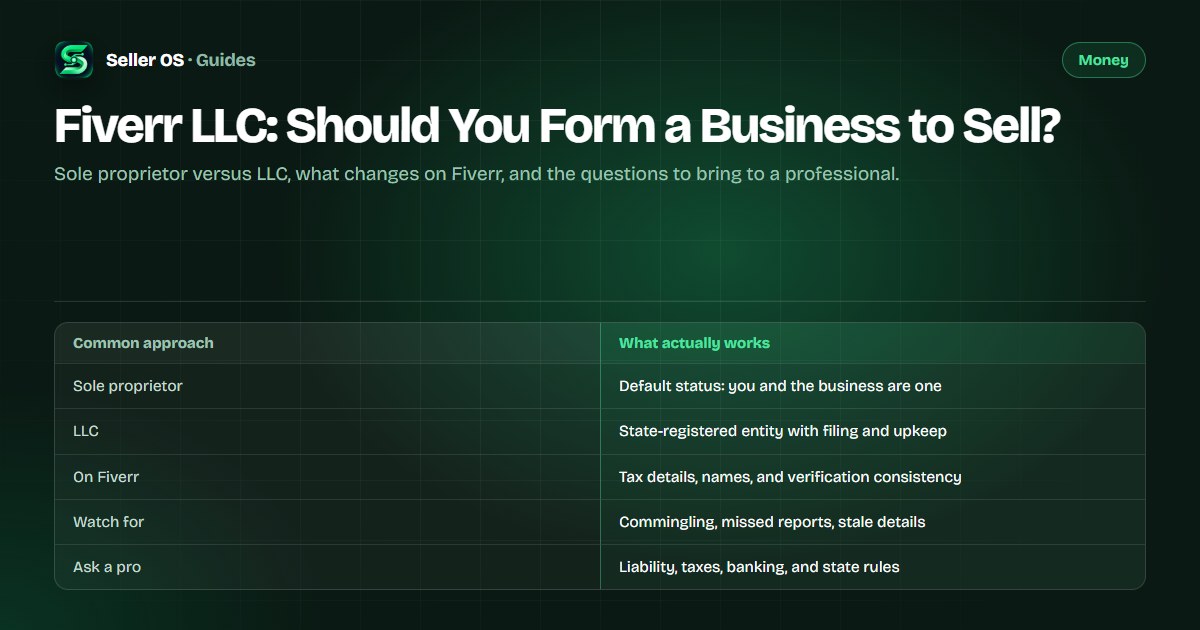
A sole proprietor is the default status for one owner working alone. You and the business are legally the same, which keeps formation and upkeep simple, but it also means personal and business finances blur easily and personal assets are exposed to business claims. Many sellers operate this way for years without issue.
An LLC is a state-registered legal entity that exists separately from you on paper. It is designed to separate the business's finances and liabilities from your personal ones, which is why sellers consider it. How much protection you actually get depends on state law and how you run the entity, and that is a question for an attorney.
| Area | Sole proprietor | LLC |
|---|---|---|
| Formation | No entity filing in most places | State registration required |
| Liability | Personal exposure to business claims | Separation designed to limit exposure |
| Banking | May use personal accounts | Business account in entity name |
| Upkeep | Minimal ongoing paperwork | Annual reports and state requirements |
| Perception | Fine for most buyers | Some clients expect an entity |
Illustrative triggers sellers use to decide
Sellers usually start considering an entity when something changes: income grows beyond pocket money, the work starts carrying a real risk of a claim, clients ask for paperwork under a business name, or the seller wants a business bank account and cleaner records. These are illustrative examples, not thresholds, and no number here is a rule.
Illustrative example: a seller earning a few thousand dollars a year from one service may decide the LLC's filing and annual upkeep are not worth it yet. A seller running a growing studio with subcontractors and larger contracts may decide the separateness is worth the paperwork. Two reasonable sellers can reach opposite conclusions from the same income.
The trigger that matters most is the one a professional surfaces: a liability exposure specific to your work, a state rule you did not know about, or a tax question with a deadline. That is why a one-line answer from the internet is never the whole story.
What changes on Fiverr with an entity
The platform does not ask for your entity type to let you sell, but a business changes some details you manage. Fiverr collects tax details in the earnings area; in the US, a W-9 declaration is updatable there, and eligible US sellers can download a 1099-K, with eligibility rules applying. Non-US sellers should check Fiverr's tax pages for the form that applies to their country. The taxes guide covers the records and forms in detail rather than repeating them here.
Names and verification are the second area. Fiverr's profile guidance allows a business name as your display name, and new sellers complete business, phone, and ID verification with status shown in Personal and Business Info. If the entity name differs from your account and payout details, keep records that connect them and ask support how to update details before a payment is blocked.
Invoicing is the third. Fiverr states that freelancers do not receive invoices for completed orders; sellers get a Statement of Earnings for 12-month periods and downloadable activity reports, and sellers may optionally invoice Fiverr for earned revenue. Client-facing invoices from the entity happen outside the platform, and the invoices guide covers the documents Fiverr does provide.
Mistakes sellers make when organizing
The first mistake is treating the filing as the finish line. An LLC has ongoing obligations, such as annual reports and state requirements, and skipping them can create fees or lose the entity's good standing. The second is commingling: paying personal expenses from the business account and mixing funds erodes the separation the entity exists to create.
The third is assuming structure changes Fiverr fees. Seller-side earnings and buyer-side fees follow Fiverr's published terms regardless of your entity. The fourth is stale platform details: a business name on the account that no longer matches the tax details or payout method invites verification questions at exactly the wrong moment.
The fifth is taking firm legal or tax conclusions from forums, including this page. Rules vary by location and change over time. General information helps you ask better questions; it does not replace the professional who answers them.
Questions for an accountant or attorney
Bring a short list. Ask which entity, if any, fits your state and your work, what liability you actually carry, and how the entity would be taxed. Ask about quarterly payments, deductions, record-keeping, and whether any election would change how you file. Ask what ongoing filings and fees your state requires and what happens if you stop.
Add the operational questions: whether to open a business bank account now, how to pay yourself, what contract templates make sense, whether you need insurance, and what changes if you hire help or take on a partner. If the answers conflict with anything you read online, the professional who knows your facts wins.
- Which structure fits my state and my work
- What liability exposure do I actually carry
- How would the entity be taxed, and when
- Which filings and fees continue each year
- How should I pay myself and keep records
Where Seller OS helps
Whatever structure you choose, the record-keeping burden is real. Seller OS keeps order history and client records in Chrome local storage, with reports and an action queue you can export on your schedule, so the monthly paperwork conversation starts from organized data rather than scattered exports.
It stops far short of this article's questions. The extension does not give legal or tax advice, does not form or manage an entity, and computes nothing about your tax position. Its job is keeping your seller-side records local and legible until a professional needs them.
Fiverr LLC: Should You Form a Business to Sell? questions
Should I form an LLC for my Fiverr business?
There is no universal answer. A sole proprietor is simpler and still valid for many sellers; an LLC adds state registration, upkeep, and a formal separation that some sellers want as income and risk grow. Because liability rules and taxes depend on your state, work, and situation, treat the decision as one to make with an accountant or attorney, not from a guide.
Does an LLC save taxes on Fiverr income?
Not automatically. An LLC is a legal structure, and how it is taxed depends on elections and your situation; forming one is not a tax-saving guarantee. Some sellers use an entity for liability separation or cleaner bookkeeping rather than taxes. Ask a tax professional to compare your options before forming anything.
What changes on Fiverr if I have an LLC?
You still sell under the same marketplace rules and fees. What changes is the detail work: tax forms collected in the earnings area, a display name that may be a business name, verification consistency between your entity, account, and payout method, and how you invoice and keep records. Fiverr does not issue invoices for seller earnings.
Can I use a business name on my Fiverr account?
Fiverr's profile guidance allows your display name to be a real name or a business name in English, without special characters other than a period or apostrophe, and it asks sellers not to reference Fiverr levels in the name. Keep the name consistent across your entity records, tax details, and payout method so verification stays simple.
Decide with a professional, not a forum
Use this guide to prepare questions, then take them to an accountant or attorney who knows your state and situation.